Creating an Ecosystem
Published: September 02, 2026
Eco-system: "A biological system composed of all the organisms found in a particular physical environment, interacting with it and with each other."
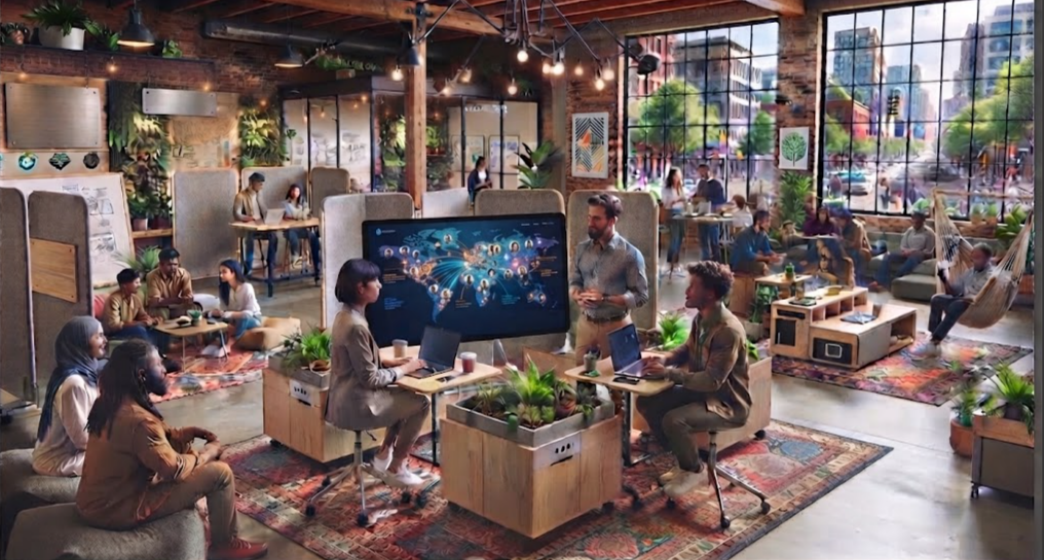
We build systems as a part of our construct as social beings to improve our efficiency. Humans have always operated in groups for survival, hunting and gathering just to live. People found each other; clans became tribes, and tribes became towns, which evolved into the ancient city-state and modern nation-state civilization.
We've come to realize that we are better off when we work together as an interdependent body, like an organism. Systems and their evolution are nothing new. There is something in our nature, though, that keeps us wanting to advance despite our many flaws, to create better.
The Modern Market: Disrupting Consolidation
An ecosystem forms when there is a need to adapt or to adopt. I live among some of the most prosperous nations ever to exist, our free market provided the foundation to make this possible. Capitalism evolved to build the hyper-corporate structure we see today. However, the last several decades have been marked by friction between the top and the bottom. While it might be ostensibly "democratic" for anyone to start a business now, limited access combined with an obsession at the top for consolidation and the acquisition of ecosystems for the skyscraper and the portfolio stifles growth.
At i-Imaginate, we believe the solution is creating market ecosystems to disrupt this behavior and lead to the next phase of the free market's evolution. Some might even call us "fanatical" or "unrealistic," but that's precisely what was said of the industrial revolution's innovations that laid the 200-year groundwork for the mechanical and digital ages. The problem is not the assembly line or simply "big business," but rather this kind of corporate clericalism. The top creates a widening gap between themselves and the bottom, cluttering competition and filtering out massive potential. You could call it competition or limited resources, but it is not the kind of democracy that allows for a market with the broadest exchange of sellable ideas and unlocked potential. A trillion-dollar-plus GDP has no excuse for this irresponsibility when we are capable of so much more.
An ecosystem that localizes and levels the competition is far more effective for adapting to the actual needs and wants of the consumer, provides better capabilities for the partner and investor, and creates a superior market for all. But it cannot just be about creating "more stuff" or "more hubs" that simply generate great ideas, deliver pitches, and swap cards. It needs to be a community that can build and maintain a house with a sustainable form like an organism—a true mini Silicon Valley—and one that imagines the possible becoming a reality.
The Culture: Building Shared Values
Missional
An ecosystem of innovation needs a common mission. For an organism to function, it needs DNA that provides order and cohesion, making the parts work together like a community to ensure efficiency and multiplication. What we value matters. Our overarching impact reflects our mission and what we truly believe. I could choose to profit and widen margins for myself. If I compete, I take. But if I create, it fuels continued building and improvement for efficiency.
Cooperative Solidarity & Reciprocity
Collective cooperation and sharing are not mutually exclusive with competition if they create necessary growth. If you're a founder with employees and understand the common sense that anything affecting them as a person affects the company, you realize the importance of human capital. Sure, people can be replaced with a vast talent pool, but if I give my laborious, starving factory worker bread for a week, I provide physical and emotional stability. This potentially multiplies his output by giving him the energy and security he needs, earning his loyalty and yielding a significant return. The impact outweighs the extra spend on energy if the producers (the workers, the people) and the laws governing their relationships are treated as integral to the overall efficiency of the business itself.
Capital and value broaden significantly from mere numbers and metrics to measuring a person's and a business's fuller potential when we instill these human-centric values. Similarly, an ecosystem of innovation that embraces this, works together, and actively exchanges benefits between everyone and drives efficiency.
Collaborative
Shared values and a common mission unlock the raw potential of collective imagination. When a community is anchored by a unifying purpose and fueled by mutual reciprocity, collaboration transforms from a corporate initiative into a natural reflex. Ideation no longer happens in isolated silos; instead, diverse founders, engineers, and thinkers cross-pollinate insights freely because trust and mutual benefit are already established ecosystem standards. This frictionless environment allows complex creative solutions to emerge organically, streamlining the journey from a nascent concept to market-ready products and the scalable businesses that house them.
The Structure: Creating Spatial Innovation
Modern Silicon Valley didn't just emerge overnight. It was built upon by its own predecessors. Once the new paradigm emerged, it was acquired, revamped, and transformed into a vibrant ecosystem for global venture—a place where even failed ideas could still be tested. But what if you didn't need to travel thousands of miles to pitch some tech lord for a few minutes of their precious time? What if you could bring that capability to where you are, making it adaptable and flexible?
Reimagining The Spatial
Every major city has its go-to spot for innovation. The problem isn't the hubs where people meet and ideas converge, nor is it the spaces leased out for commerce and events; rather, it is the lack of access and processes needed to unlock innovation's larger potential.
On an annual basis, immense sums go into commercial leasing simply to create a center for density. We need to rethink how space is utilized for ecosystems, as well as the processes through which connections form and ideas turn into success. Imagine mini localized Silicon Valleys, but without exclusive reliance on traditional corporate structures—flexible and adaptable for a community, an event, an idea, or a scalable project.
If I have a brilliant idea or even a prototype, I shouldn't have to wait for the next tech week or a happy hour days away. Instead, I could see who is already nearby using a localized ecosystem or platform to streamline and match compatibility, then adapt the space virtually or meet in proximity. I can bring together developers, engineers, and Go-To-Market teams, and signal to other like-minded individuals nearby. Intent meets reality and saves time.
Hubs will always be focal points for meeting, but what if they were supplemented by these more organic spaces that are cross-pollinatable and multiplicative? Imagine your city dotted with innovative spaces of all kinds and sizes, connected by an ecosystem that turns them into a cohesive community.
i-Imaginate is currently working on this model, matching platforms and real-time interfaces to make this a true reality.
Rethinking Events
I've attended many great tech events, but most tend to follow a rigid format. Traditional events inform and create an environment for opportunity, but what is truly needed is more active participation from the ecosystem. There are many ways to structure an event—whether informational, networking, or workshop-based—yet a common bottleneck is time and goal efficiency.
Imagine concentric layers of participation where practically everyone has a role, for any event kind, attendees move through concentric tiers of active participation. Combining UX principles with precision breakout groups and dynamic rotations ensures many possibilities and every voice has a timed, focused role. This shifts the event from a passive lecture to an efficient, high-yield solutions engine—drastically reducing downtime while crushing goals.
Conclusion: The Path Forward
Innovation should never be about asking for permission. It is about building—the localized potential, the shared DNA, and the living networks—that allows human ingenuity to scale naturally from the ground up.
At i-Imaginate, we aren't just envisioning this or how spaces are utilized; we are making how humans connect, collaborate, and create together more efficient. The next era of progress doesn't need to wait for the top of a corporate skyscraper. It will be grown right where you are, one interconnected community at a time.